
Boyd Polhamus has spent years around some of the biggest rodeos in the country, and from that vantage point, he has seen a truth that too many horse owners overlook. The ground matters. Not just at major competitions, but every day in the practice pen, where horses spend far more time than they do in front of a crowd.
“You will buy a trailer worth hundreds of thousands of dollars to make sure your horse rides well,” Polhamus says. “The best thing you can do for that investment is make sure the ground where you practice and compete is as safe as it can be.”
That perspective gets to the heart of a major gap in the rodeo world. Competitors spend heavily on horses, trailers, supplements, and veterinary care, but the footing beneath those horses often gets less attention than it should. According to Polhamus, that is a mistake.
As a rodeo announcer, he is not looking at just one horse or one event. He is seeing the full picture. Every run, every stop, every slip, every clean turn, and every problem that shows up in an arena. That broad view has shaped how he thinks about ground quality and why it matters so much.
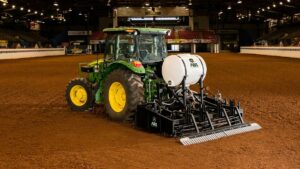
His first real introduction to the ABI SpeedMaster came at the Tri-State Rodeo in Fort Madison, Iowa. What stood out to him immediately was the build quality.
“The first thing that struck me was how it was built,” he said. “I walked around it and thought, wow, this thing is going to last a while. You could not wear it out.”
But durability was only part of the story. Once he saw it working, he understood why it had such a strong reputation. “I watched Ron Stevenson work the ground with it, and it was one of the most amazing pieces of equipment that I have ever seen in my life.”
That moment changed his thinking. He realized that arena ground preparation had not kept pace with the demands being placed on horses and riders. “There is a real hole in the rodeo and speed event world,” he said. “We have been using the same kind of technology for 30 years.”
That challenge becomes even more obvious when you look at how many different events share the same ground. Barrel racers want something different from bulldoggers. Stock contractors need something different from both. Every event puts different stress on the surface, and every one of them expects the footing to perform.
“Bulldoggers want a certain kind of ground. Barrel racers want a certain kind of ground. Stock contractors want a certain kind of ground,” Polhamus said. “And we have to find a way to meet in the middle.”
That is where versatility becomes so important. A good piece of equipment has to adjust to the event, the horse, and the conditions. For Polhamus, that is one of the biggest advantages of modern arena management tools.
“The hydraulics, the different options, the ability to change depth. It is an amazing piece of equipment because it lets you control the footing.”
Still, Polhamus believes the most important place for that kind of equipment is not always the competition arena. It is the practice pen.
“The most important place that should have this kind of equipment is the competitor’s backyard.”
Why? Because that is where horses spend the most time, and that is where many injuries likely begin. Riders may only notice the arena at competition time, but their horses are training every day on whatever ground happens to be available at home.
“They spend the majority of their time at home working on something that is less than what they compete on,” Polhamus said. “I would venture to guess that more injuries occur in the home practice pen than they do where they are competing for prize money.”
That is a sobering thought, but it makes sense. Repetition on poor or inconsistent footing can create wear and tear long before a horse ever steps into a competition arena. Over time, that adds up.
Polhamus compares ground quality to other expenses horse owners already accept as part of the game. Supplements, injections, and veterinary care all have their place, but they are often reactive. Ground quality is different. It is preventive.
“You are going to spend money on supplements. You are going to spend money on injections to keep your horse sound,” he said. “The best thing you can do for your horse investment is to make sure your ground is as safe and sound as it possibly can be.”
Then comes the line that says it best: “The best insurance you could have for your horse is good ground.”
That message is especially relevant when you think about how many people still rely on old, makeshift methods to maintain their arenas. Polhamus has seen it all, from homemade tools to outdated routines that may make the top layer look acceptable without actually solving the problem underneath.
“We live in a world where people will take a rototiller and a piece of cyclone fence and drag it behind and think they have their arena worked,” he said.
The trouble is that the surface can look fine while the ground underneath remains uneven, inconsistent, or unsafe. “The average rider does not see below the surface. All they see is that top layer,” he explained. “It is that two to four inches underneath that affects the result.”
That is where horse safety and performance are won or lost. If the footing is wrong, the horse knows it. And if the horse does not feel safe, the run changes. “If a horse does not feel safe, he is not going to give you his best.”
That simple idea connects everything Polhamus is saying. Ground affects confidence. Confidence affects performance. And performance affects both results and safety.
At the end of the day, Polhamus brings the conversation back to responsibility.
“Do we not owe it to the horses?”
It is a fair question. His brother is a farrier, and the phrase “no foot, no horse” is part of the same mindset. If the horse is not sound, nothing else matters. And if the ground is not right, soundness becomes harder to protect.
That is why his final message lands so clearly. Good ground is not a luxury. It is not an extra. It is one of the most important investments a horse owner can make.
“The best insurance you can buy for your horse is good ground.”
Key Investment Area | Purpose/Benefit | Polhamus’ Perspective
|
|---|---|---|
Ground Quality | Safety, soundness, and confidence. | “The best insurance you could have for your horse.” |
Practice Pen Prep | Prevents long-term wear and tear. | The most important place to have quality equipment. |
Modern Equipment | Versatility across different rodeo events. | Essential for controlling the footing for various needs. |
Preventive Care | Reduces need for reactive injections/vet care. | Safety and soundness are won or lost in the footing. |
Bad footing increases injury risk. Good ground keeps horses safer, more confident, and more consistent.
He says good ground is the best insurance for your horse and protects your long-term investment.
Most injuries likely happen in the practice pen, where horses spend most of their training time.
Yes. Most daily work happens there, so poor footing can build long-term stress and lead to injury.
Unsafe or inconsistent footing reduces confidence and leads to weaker, less consistent performance.
They often smooth the surface but don’t fix deeper inconsistencies below the top layer.
Yes. Barrel racing, bulldogging, and other events all require different footing conditions for safety and performance.
Not instead of it, but it is preventive. Good footing helps reduce injuries before they require treatment.
To apply for financing and to learn about our latest financing promotions call 877.788.7253. Financing programs are offered by Sheffield Financial, a division of Truist Bank. Member FDIC. Subject to credit approval. Approval, and any rates and terms provided, are based on credit worthiness. Other financing offers are available. See your local dealer for details. Bureau risk score alone does not guarantee rate eligibility; other underwriting criteria may apply. Minimum amount financed $1500.00; Maximum amount financed $75,000.00. Other qualifications and restrictions may apply. An Origination Fee of $150.00 will be added to the amount financed in the above example. Offer effective on eligible and qualified units purchased from a participating Sheffield dealer. See dealer for product eligibility and qualifications between 8/1/2026 and 10/31/2026. Offer subject to change without notice
No obligation.
Mon-Thurs 8AM – 8PM and Fri 8AM – 5PM EST