
Shredding is the single most important thing a manure spreader does. It turns manure from a liability into free fertilizer, and ABI’s 2-stage inline shred and spread system is built specifically to do it right. Use ABI’s manure spreader Machine Match to find out which ABI spreader is for you.
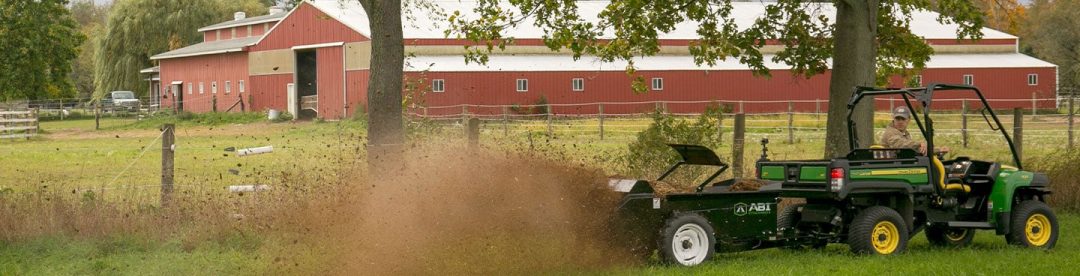
Picture a chunk of manure the size of a baseball, dropped onto your pasture. It doesn’t disappear. Depending on the weather, it can take three to four months, sometimes up to a full year, to fully break down on its own. The whole time it’s sitting there:
That’s one clump. A whole field covered in them is a whole field working against you.
The core fact worth remembering: spreading manure and shredding manure are not the same thing. A machine that just dumps large clumps onto a field hasn’t solved anything. It’s relocated the problem.
The short answer: smaller particles expose more surface area, and surface area is where every beneficial process happens.
Surface area is where oxygen reaches the material, where sunlight sterilizes it, and where nitrogen gets locked into soil instead of drifting off as gas. None of that happens in the middle of a clump. It happens at the surface.
More exposed surface means faster drying, faster decomposition, and more nitrogen conserved. That single relationship is the reason shredding matters more than any other spreader spec.

Parasite eggs shed in manure aren’t dangerous yet. Over one to four weeks, they develop into an infective stage capable of making a horse sick. During that early window, the eggs and young larvae are fragile: vulnerable to heat, sunlight, and dry air. Once they finish developing, they toughen up and can survive on pasture for months.
Fine, thin shredding exposes eggs and young larvae to the conditions that kill them before they harden, right when they’re still vulnerable. It’s not a replacement for regular deworming and pasture rest, it’s a complementary practice. Done consistently, it meaningfully cuts down how many parasites make it to the dangerous stage in the first place.
You didn’t take on horses, cattle, or a farm because you wanted to become an expert in parasite biology and nitrogen chemistry. That is our job. You wanted healthy animals, land that looks like you’re taking care of it, and a routine that doesn’t eat your whole week.
But manure doesn’t care what you wanted. Left unshredded, it works against every one of those goals at once: chronic flies, creeping vet bills, patchy pasture, and nitrogen you paid for evaporating into the air while you buy bagged fertilizer to replace it.
That’s the real cost of a spreader that moves manure without actually processing it. It looks like progress. It isn’t.
We build equipment for people actually living this, real farms, real horses, real acreage, not massive commercial operations with a full-time crew. We’ve seen what a spreader that only shreds the top of the load does to a property over a season, and we’ve seen what changes once shredding is done right: calmer horses, fewer flies, greener pasture, and nitrogen that actually stays where you put it.
That’s why every ABI manure spreader is engineered around solving the shredding problem specifically, not just moving manure from a box to a field.
Some spreaders only have a single beater near the top of the box. It slings out whatever’s closest to it and never touches the manure underneath, so the top of your load might look fine while the rest comes out in chunks.
Every ABI manure spreader runs a 2-stage inline shred and spread system. Every part of the load, top, middle, and bottom, passes through a dedicated shredding stage before it ever reaches the part that throws it onto the field. Nothing skips that step.
Find out what manure spreader is for you by using Machine Match!
Walk back through what you just spread. Two minutes tells you everything.
Switch to genuine fine shredding, done consistently, and most owners notice real changes within a single season: fewer flies, less odor, greener and more even pasture, and real money saved on nitrogen you’re no longer losing to the air. That’s the difference between a spreader that just empties its box and one that’s actually doing the job you bought it for.

Compare exact specs across every ABI spreader size, from small ground drive units to large PTO models, on the full comparison chart.
Running a smaller operation — a few horses, a hobby farm, something pulled with an ATV, UTV, or lawn tractor? Start with the 25 cubic foot spreader for up to four horses, the 50 cubic foot ground drive for up to eight, or the 65 cubic foot ground drive for up to eleven. All ground driven, no PTO tractor required. Details on the ground drive support page.
Running more animals, more acreage, or a tractor with a PTO? The lineup runs from the 50 cubic foot PTO up to the 85 cubic foot, 125 cubic foot, and 185 cubic foot models. Details on the PTO support page.
Want a tractor-towed spreader without needing a PTO? The 85 cubic foot ground drive bridges that gap.
Browse the full manure spreader lineup, or if you’d rather just talk it through, reach out to an ABI product specialist. No pressure, no obligation, just someone who can help you match the right size and drive type to your operation.
Shredding — Breaking manure into small, uniform pieces before it’s spread, instead of leaving it in large clumps.
Volatilization — Nitrogen escaping into the air as gas instead of staying in the soil where plants can use it.
Surface area — The outer part of something exposed to air, sunlight, and soil. Smaller pieces of manure have more surface area for the same total amount.
Infective larva — The stage of a parasite’s development where it’s capable of infecting a grazing animal.
2-stage inline shred and spread system — ABI’s design where every part of a manure load passes through a dedicated shredding step before it’s spread, so nothing comes out unshredded.
Machine Match — a product picker for ABI’s customers and website visitors.
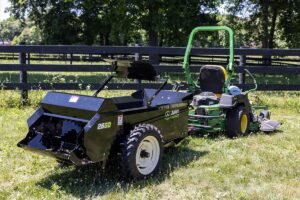
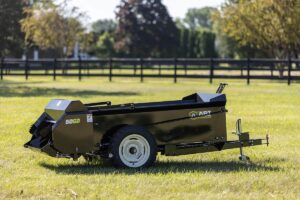
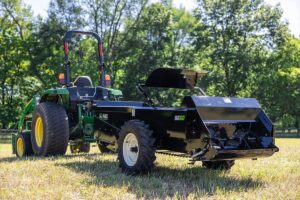
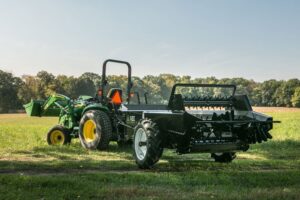
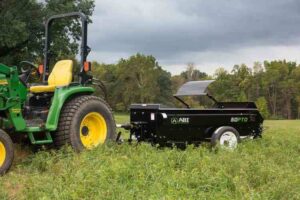
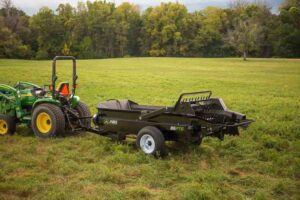
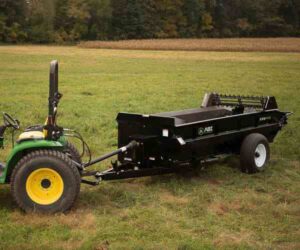
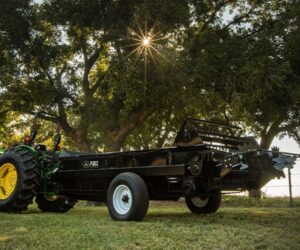
ABI spreaders aren’t just for horse manure: we spread it all! ABI’s muck spreaders handle all kinds of animal manure and compost at any phase of decomposition.
It’s worth spreading. Manure is free fertilizer, full of the same nutrients you’d otherwise buy in bags. The key is spreading it properly so it helps your land instead of creating new problems.
No. It reduces how many parasites survive to the dangerous stage, but regular deworming and pasture rest are still necessary.
Commonly three to four months, sometimes up to a full year, depending on weather and conditions.
To apply for financing and to learn about our latest financing promotions call 877.788.7253. Financing programs are offered by Sheffield Financial, a division of Truist Bank. Member FDIC. Subject to credit approval. Approval, and any rates and terms provided, are based on credit worthiness. Other financing offers are available. See your local dealer for details. Bureau risk score alone does not guarantee rate eligibility; other underwriting criteria may apply. Minimum amount financed $1500.00; Maximum amount financed $75,000.00. Other qualifications and restrictions may apply. An Origination Fee of $150.00 will be added to the amount financed in the above example. Offer effective on eligible and qualified units purchased from a participating Sheffield dealer. See dealer for product eligibility and qualifications between 8/1/2026 and 10/31/2026. Offer subject to change without notice
No obligation.
Mon-Thurs 8AM – 8PM and Fri 8AM – 5PM EST