
Learn how mechanical desiccation with an ABI manure spreader breaks the horse parasite life cycle, reducing pasture reinfection alongside your deworming program. Use ABI’s manure spreader Machine Match to learn which model is for you.

Every horse owner knows the deworming schedule by heart. What most do not realize is that a strict chemical rotation can still fail if the pasture itself keeps reinfecting the herd. Strongyle (a common type of internal worm parasite in horses) larvae (the young, immature stage of the parasite) survive by hiding inside moist, undisturbed manure. If that manure never gets broken down and exposed to sun and dry air, your horses can pick up new parasites within days of every treatment. Mechanical desiccation (drying out), using an ABI manure spreader to shred manure into a thin layer that sun and air can fully penetrate, gives you a second, non-chemical line of defense alongside your vet’s deworming program. See ABI Manure Spreaders →
You follow the schedule, run fecal egg counts (a lab test that measures how many parasite eggs are in a manure sample), rotate chemical classes, and your horses still get reinfected within weeks. That is not a failure on your part, it is a gap in the strategy. Every reinfection means another vet bill, another round of chemicals, and another season of watching the same problem come back no matter how careful you are. If the pasture stays loaded with viable larvae, you are dosing your herd and walking them right back into the source.
Small strongyles, the parasite most horse owners are actually fighting, already show widespread, well-documented resistance (when a drug that used to kill a parasite stops working as well because the parasite has evolved) to benzimidazole and pyrimidine (two families of dewormer drug) dewormer classes. Resistance to macrocyclic lactones (a third dewormer drug family, which includes ivermectin and moxidectin) is also emerging in some regions. That means the margin for error on chemical control alone is shrinking. Every strategy that reduces how many larvae reach your horse in the first place takes pressure off drugs that are already losing ground on at least two major fronts. With an ABI manure spreader, it is only half the battle.
Owners who do everything by the book still end up fighting reinfection, because nobody told them the pasture itself is half the battle. That is the gap ABI Attachments builds equipment to close. We are not a veterinary clinic, so we can’t advise you to skip your deworming program. We build the equipment that handles the half of the problem chemicals were never designed to touch: the manure sitting in your pasture right now, breeding the next generation of larvae.

Strongyle eggs hatch into larvae that need moisture and shade to survive long enough to migrate onto grass and get re-ingested. An intact manure clump gives them exactly that protection. Dragging a pasture without breaking the clump apart can spread live larvae nurseries wider instead of destroying them, which is a common mistake with chain harrows (a simple mat of chain links pulled behind a vehicle to drag and break up manure) and dump-style spreaders (older equipment that tips manure out in piles rather than shredding it).
Desiccation, not heat alone, is what kills larvae. But UV (ultraviolet light, the part of sunlight that damages the larvae) only penetrates a shallow depth into solid matter, so a thick clump shields everything underneath. A thin, evenly shredded layer does not. This is the core mechanical difference between equipment that just relocates manure and equipment that actually neutralizes it.
Timing matters as much as equipment. Spreading in cool, damp, or overcast conditions scatters live larvae instead of killing them. Spreading only works in real heat and sun. A wet spring morning can make the problem worse, not better, no matter how good the spreader is.

A chain harrow drags clumps across the ground without breaking them apart, so intact larvae nurseries just end up spread over more square footage. A standard dump-style spreader drops manure in heavy piles rather than a fine layer, which recreates the same moist, shaded core larvae need. Neither gets manure thin enough for real sun and air exposure. The shredder-beater (the mechanical part inside an ABI spreader that chops and flings manure apart instead of dropping it whole) mechanism is the part doing the actual work here, not just the act of spreading.
An ABI shredder-beater system pulverizes manure into a thin, even layer instead of dropping heavy clumps, so there is no protected moist center left for larvae to hide in. Compare ABI Spreaders →
A fine, even layer on a hot, dry day is what sunlight can fully penetrate, and the condition that actually kills larvae instead of relocating them.
A lightweight Ground-Drive spreader (a spreader powered by its own wheels turning, light enough to tow behind an ATV or UTV instead of a full tractor) makes near-daily spreading realistic, without the soil compaction (when soil gets packed down tight from heavy equipment, leaving less room for air and water) a heavy tractor causes. Little and often beats one heavy monthly pass.
Every season you put this off is another season of the same loop: deworm, reinfect, deworm again, while resistance quietly builds in a parasite population that already has the upper hand against several major drug classes. Manure piles keep breeding flies alongside larvae. Untouched ground stays compacted and drains poorly, losing the pore space (the tiny gaps between soil particles where air and water sit) it needs right when your pasture needs to recover most. And if you are still running an old spreader, standard coated steel is already corroding from the inside behind every scratch, so you are one bad season away from replacing the equipment too, on top of everything else.
Fewer larvae reaching the grass. Fewer flies breeding in undisturbed manure. Soil that drains instead of compacts. A deworming program that finally has real backup instead of fighting the reinfection cycle alone. And equipment built in COR-TEN steel (a weathering steel that forms a protective rust-like layer on its surface, which slows down further rusting) with an epoxy liner (a hard protective coating inside the spreader box for extra scratch and corrosion resistance) that is still structurally sound years from now, not rusting through from the inside the way standard coated units do.
Don’t forget, to use ABI’s manure spreader Machine Match to find your perfect manure spreader for your tow vehicle!
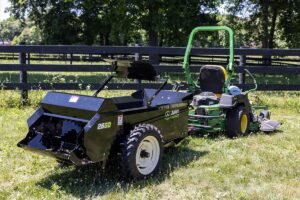
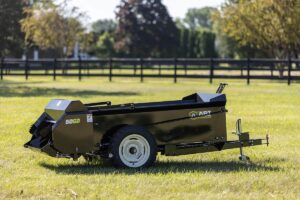
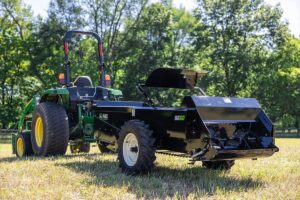
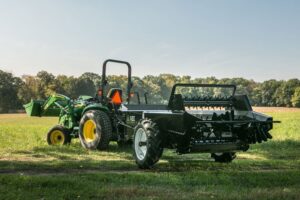
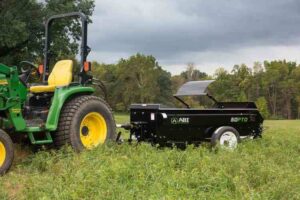
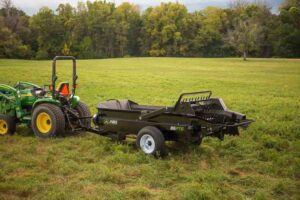
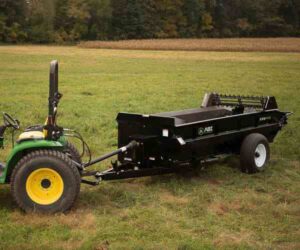
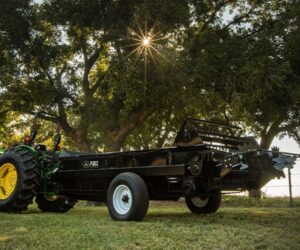
Machine Match — a product picker made by ABI Attachments to help customers and users know what size and model of an ABI attachment is for them.
Strongyles — a common type of internal worm parasite in horses.
Larvae — the young, immature stage of a parasite, between egg and adult.
Desiccation — drying out.
UV (ultraviolet light) — the part of sunlight that damages parasite larvae.
Anthelmintic — the medical term for a dewormer.
Fecal egg count — a lab test that counts parasite eggs in a manure sample to measure parasite load.
Resistance — when a drug that used to kill a parasite stops working as well because the parasite has evolved.
Benzimidazole, pyrimidine, macrocyclic lactone — different chemical families of dewormer drugs; ivermectin and moxidectin fall under macrocyclic lactones.
Shredder-beater — the mechanical part inside an ABI spreader that chops and flings manure apart instead of dropping it whole.
Ground-Drive spreader — a spreader powered by its own wheels turning, light enough to tow behind an ATV or UTV instead of a full tractor.
Chain harrow — a mat of chain links pulled behind a vehicle to drag and break up manure.
Dump-style spreader — older equipment that tips manure out in piles rather than shredding it thin.
Soil compaction — when soil gets packed down tight, usually from heavy equipment, leaving less room for air and water.
Pore space — the tiny gaps between soil particles where air and water sit.
COR-TEN steel — a steel that forms a protective rust-like layer on its surface, slowing further corrosion.
Epoxy liner — a protective coating inside the spreader box for extra scratch and corrosion resistance.
As frequently as conditions allow, ideally near-daily during hot, dry stretches. Larvae migrate into soil or onto grass within weeks if manure sits too long, so a lightweight Ground-Drive spreader that makes frequent passes practical is more effective than one heavy monthly application.
A chain harrow drags manure without breaking it apart, which can spread intact larvae nurseries over a wider area. A shredder-beater pulverizes manure into fine material thin enough for real UV and air exposure, which is what actually kills larvae rather than relocating them.
No obligation.
Mon-Thurs 8AM – 8PM and Fri 8AM – 5PM EST
To apply for financing and to learn about our latest financing promotions call 877.788.7253. Financing programs are offered by Sheffield Financial, a division of Truist Bank. Member FDIC. Subject to credit approval. Approval, and any rates and terms provided, are based on credit worthiness. Other financing offers are available. See your local dealer for details. Bureau risk score alone does not guarantee rate eligibility; other underwriting criteria may apply. Minimum amount financed $1500.00; Maximum amount financed $75,000.00. Other qualifications and restrictions may apply. An Origination Fee of $150.00 will be added to the amount financed in the above example. Offer effective on eligible and qualified units purchased from a participating Sheffield dealer. See dealer for product eligibility and qualifications between 8/1/2026 and 10/31/2026. Offer subject to change without notice