
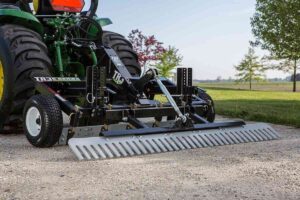
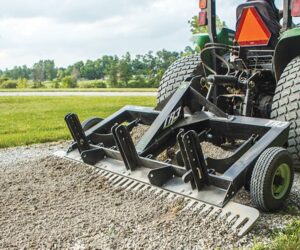
On an ABI attachment, a tire is not just a tire. It is a stabilizing wheel. That distinction is not marketing language. It is a functional difference that directly controls depth, consistency, and finish quality across every pass of the machine.
When you look at the wheels on the TR3 Rake and the TR3 E-Series, they appear similar at first glance. Both use a 16 inch wheel. Both use a five lug rim. Both include serviceable bearings and grease fittings.
But how they behave on the ground, and how they control the tool, comes down to two very different engineering approaches.
A stabilizing wheel is not a transport component. It is a depth control system.
As the attachment moves forward:
This means scarifiers, leveling blades, and grooming components cannot dig deeper than what the wheel allows. The wheel becomes the physical reference point for the entire tool.
In practice, that produces:
Feature | TR3 | TR3 E-Series |
Tire Type | Foam filled | Air filled |
Wheel Weight | 32 lbs | 22 lbs |
Diameter | 16 inches | 16 inches |
Lug Pattern | 5 lug | 5 lug |
Primary Use | Commercial and high-hour work | Residential and compact tractor use |
Wheel Block Orientation | Horizontal adjustment | Vertical adjustment |
Depth Control Method | Forward and backward position changes | Three position height settings |
Crown Control Method | Left/right offset wheel positioning | High/low wheel positioning |
Design Priority | Durability and continuous use | Simplicity and weight reduction |
Serviceability | Greaseable hubs, replaceable bearings | Greaseable hubs, replaceable bearings |
The TR3 wheel system is built for commercial environments where uptime and durability matter more than weight savings.
Foam filling eliminates the risk of flats in the field. That matters when the machine is running long days in rough conditions where downtime is expensive.
The added weight also improves stability. At 32 pounds per wheel, the stabilizing system contributes to consistent frame control when working at scale.
This setup is designed for:
The TR3 uses a horizontal adjustment system that moves the wheel forward and backward.
That adjustment impacts four functional areas:
This system provides a wider range of adjustment because commercial work demands flexibility across different tractors and job conditions.
The E-Series is designed specifically for compact and subcompact tractors where weight and simplicity matter more than maximum durability cycles.
Air filled tires reduce overall weight and improve surface compliance.
At 22 pounds per wheel, the system is significantly lighter, which reduces strain on smaller tractors and improves balance during operation.
Air fill also has a functional advantage in loose materials like sand. The tire can conform slightly to surface variations, helping maintain consistent depth in arenas and softer soils.
Instead of moving forward and backward, the E-Series adjusts depth vertically.
This simplifies setup and reduces adjustment complexity for residential users.
Crown control is still possible by placing one wheel higher and the other lower, creating a controlled tilt in the frame.
Across both models, stabilizing wheels solve the same core problem: controlling depth without relying on operator skill.
That produces three consistent outcomes:
The tool cannot exceed the wheel set depth, regardless of terrain variation.
Different operators achieve the same surface finish without re-training.
Less hand raking, less re-passing, fewer inconsistencies in final grade.
This becomes especially important in commercial or multi-operator environments where consistency matters more than individual technique.
The difference between the TR3 and TR3 E-Series stabilizing wheels is not just weight or tire type. It is the difference between commercial durability engineering and compact tractor optimization.
Both systems solve the same problem: controlling depth without relying on operator precision alone. They just solve it in different ways based on machine size and application.
That is why on ABI attachments, a tire is never just a tire.
It is a depth control component that sets and maintains the working height of the entire attachment, ensuring ground engaging tools operate within a controlled range.
Foam fill prevents flats in commercial environments and adds weight for improved stability during long operating hours.
Air fill reduces weight for compact tractors and provides better compliance in loose or sandy surfaces such as horse arenas.
Yes. Both systems use wheel position as the primary method of adjusting how deep the tool engages the ground.
The TR3 is better suited for heavier commercial use and larger tractors. The E-Series is better suited for residential compact tractor setups.
Yes. They limit maximum depth automatically, which makes results more consistent across different operators.
To apply for financing and to learn about our latest financing promotions call 877.788.7253. Financing programs are offered by Sheffield Financial, a division of Truist Bank. Member FDIC. Subject to credit approval. Approval, and any rates and terms provided, are based on credit worthiness. Other financing offers are available. See your local dealer for details. Bureau risk score alone does not guarantee rate eligibility; other underwriting criteria may apply. Minimum amount financed $1500.00; Maximum amount financed $75,000.00. Other qualifications and restrictions may apply. An Origination Fee of $150.00 will be added to the amount financed in the above example. Offer effective on eligible and qualified units purchased from a participating Sheffield dealer. See dealer for product eligibility and qualifications between 8/1/2026 and 10/31/2026. Offer subject to change without notice
No obligation.
Mon-Thurs 8AM – 8PM and Fri 8AM – 5PM EST