
Learn what materials make a manure spreader, their impact on the durability and longevity of the equipment, and how ABI manure spreaders are meticulously engineered to last.
If you own horses, cattle, swine, or other livestock, you know that managing manure is a substantial part of your job. It’s everywhere, it’s constant, and it must be dealt with.
Have you noticed your manure spreader beginning to corrode? Have parts ceased working due to rust, warping, or damage? In this article, you’ll learn how to identify a quality manure spreader over a gimmick-laced, poor-quality spreader. Keep reading to find out how proper material selection and manufacturing processes are key elements that determine the longevity and durability of a manure spreader.
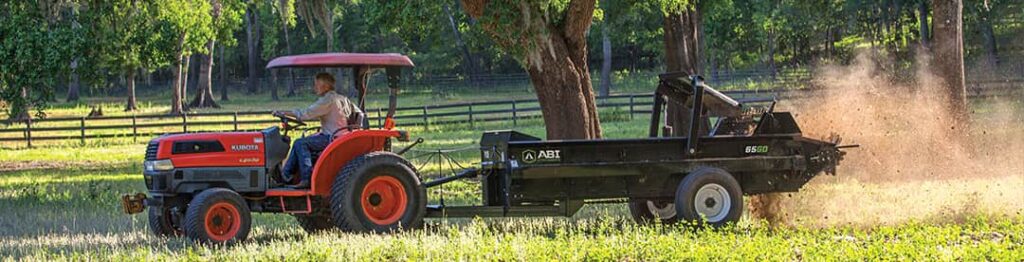
There are countless options available for manure management. These include manure spreaders, separators, and composting drums. Manure spreaders are among the most commonly used options for manure management. When evaluating a manure spreader, people often look for an implement that is designed to effectively break up clumps, spread manure evenly, and work quickly to save them time. While these are important features to identify when shopping for a spreader, it’s important to also look at the material properties of a spreader.
There are a variety of materials companies select from when designing and manufacturing manure spreaders, including wood, steel, and plastic. As a consumer, it can be difficult to sift through the multitude of available manure spreader options and determine which brand’s quality is superior to the others. However, knowing which materials to avoid and to seek out will help you narrow your search, identify a spreader’s quality, estimate its value, and ultimately, make an informed decision about which spreader is worth your investment.
A good quality spreader, crafted from corrosion-resistant materials, will be able to keep up with load after load of muck, urine-soaked clumps, and organic material, without failing. ABI’s innovative engineering and material selection make our manure spreader line your ultimate option for manure management, no matter the size of your property or type of animals.
At ABI, we are transparent about the materials we use, so that you can make an informed decision. Keep reading to see what materials our manure spreaders are crafted from, and how they help our manure spreaders outperform the competition.

When it comes to durability and longevity, wood and plastic spreaders pale in comparison to spreaders made of metal. However, the type of metal used impacts a spreader’s corrosion resistance and longevity. Corrosion and rust will degrade and eventually debilitate a low-quality manure spreader, condemning it to the attachment graveyard. If you spread manure frequently or are looking for a manure spreader that is built to last, it’s important to know which metals are capable of resisting the highly corrosive nature of animal waste.
It’s no secret that animal waste is highly potent and damaging to materials, including metals. However, while it may seem that manure solids are the main culprit, it’s actually the urine found within manure clumps that causes the greatest damage to a spreader over time. Animal urine contains uric acid and ammonia, which are extremely corrosive and can quickly damage a metal manure spreader if the components are not designed to withstand consistent contact with animal waste.
ABI COR-TEN steel manure spreaders are designed specifically to resist corrosion through contact with manure and maintain durability under heavy use. They can handle all kinds of animal manure and compost at any phase of decomposition. Keep reading to find out why ABI manure spreaders are #1 American bestsellers, and why our material selection and manufacturing processes make our manure spreaders the best in the business.

Steel is a commonly used metal in manure spreader manufacturing. However, not all steel is created equal. Certain types of steel are more resistant to corrosion when exposed to animal waste.
Mild steel is a cost-effective steel used to create manure spreader beds and components. It is not corrosion-resistant and, when exposed to manure solids and urine, will quickly begin to rust. To prolong a mild-steel spreader’s lifespan, engineers apply a corrosion-resistant layer, called powder coating, to the exposed steel. The powder coating creates a barrier between the mild steel and muck, shielding the metal from contacting the manure. This prevents corrosion.
However, powder coating cannot maintain its strength over long periods of time when consistently exposed to animal waste. As the spreader is used, the powder coating layer gets scratched and chipped, compromising the barrier. Because mild steel has no corrosion resistance, when urine and solids seep through small cracks in the powder coating, the steel will begin to rust. By the time the scratches grow large enough to notice, it’s too late. Mending the scratches will have little effect because the manure particles have contacted the metal. You can seal the scratches, but your spreader will begin to rust from the inside out. For consumers looking for a manure spreader that will last for decades, or who use their manure spreader frequently, a powder-coated mild steel spreader is not the answer, as it cannot hold up to constant use.
Galvanized steel (steel covered in a protective zinc layer) is another material used in manure spreader manufacturing. The steel gets its name from how it is created. Galvanization, the process of dipping steel in molten zinc, is how this type of steel maintains corrosion resistance. Like powder coating, the zinc acts as a protective barrier. However, galvanization protects the metal differently from powder coating. Powder coating sits on top of the steel, but once this layer is compromised, it exposes the metal to damage. However, with galvanization, the molten zinc bonds directly to the steel, integrating protection directly into the steel structure. When the metal comes in contact with the corrosive material, the zinc reacts with the material, leaving the steel underneath intact.
In many industrial and marine settings, galvanized steel is a highly sought-after material due to its corrosion-resistant properties that perform well in extreme weather conditions and in water. However, when used in manure-spreading applications, this type of steel loses its corrosion-resistant capability over time. In other applications, the zinc barrier fights corrosion and protects the steel layers underneath. However, after years of use, the zinc barrier will begin to weaken. When this happens, the ammonia and uric acid in animal urine can degrade the barrier, ultimately causing the steel to rust and corrode.
Stainless steel is a highly corrosion-resistant alloy that maintains its signature satin finish over time. Stainless steel gains its corrosion resistance primarily from chromium, which is added to the steel during production. Like galvanized steel, stainless steel is a popular material for industrial and marine settings, as well as for common household items such as cutlery and pans.
While stainless steel may appear as the ultimate material for manure spreaders, a significant downside of the material is its steep price to manufacture. This results in higher costs for the consumer. Purchasing a manure spreader crafted entirely of stainless steel components is a significant investment, which can be a burden on small farm owners who want the stress-free, corrosion-resistant results that stainless steel provides, but can’t afford the high price tag.
However, advancements in metal manufacturing have led to the development of stainless steel alternatives that are comparable in quality and less expensive. One of these innovations is COR-TEN steel.
ABI manure spreaders are manufactured with COR-TEN steel, a type of weathering steel with extreme corrosion resistance. COR-TEN steel, an alloy owned by U.S. Steel Corporation, was invented in the 1930s for railroad infrastructure. The name COR-TEN represents two properties of the steel. “COR” stands for corrosion resistance, and “TEN” represents tensile strength.
COR-TEN steel has been adopted by many industries due to its ability to resist corrosion in harsh weather conditions. Although not its original intended use, this steel is also highly resistant to corrosion when exposed to animal waste.
Uncoated COR-TEN steel is similar to galvanized steel in that it can protect itself from damage. As the uncoated steel comes in contact with other materials, the steel develops an oxide layer. This oxide layer creates a patina on the surface to protect the rest of the metal from being compromised. However, this patina is sometimes considered visually unappealing. This is why ABI manure spreaders are painted with an acrylic urethane topcoat. This coating adds an extra layer of protection on our COR-TEN steel and ensures that no patina forms.

When you buy a steel spreader, you expect it to last for the long haul, not just a few seasons. You don’t mess around, and neither do we. ABI engineers have meticulously designed our manure spreaders to thrive, year after year. Every component is built to withstand high levels of urine, manure solids, and other materials without corroding, rusting, or rotting. ABI manure spreaders are tank-tough, from top to bottom.
ABI spreaders are built with trusted, reliable materials, allowing you to get the job done with confidence. Need more reasons to trust us? Our manure spreaders come with three warranties: a limited 10-year warranty for the box, frame, and apron chain, a limited lifetime warranty for the poly-wood flooring, and a 36-month limited warranty for mechanical workings and components.
At ABI, our passion is to empower hardworking people with the tools they need to get their groundwork done. We care. We listen. We support. Our product expert team connects with property owners, ranchers, farmers, equestrians (and more!) daily to help unlock each person’s specific goals, needs, and vision for their property.
To find the best manure spreader for your property, pasture, process, and animals, view our full line here or speak to an expert at 877-788-7253.
“Basic Facts About Stainless Steel.” International Stainless Steel Forum, World Stainless, 2025, worldstainless.org/wp-content/uploads/2025/02/basic-facts-about-stainless-steel.pdf.
“Galvanized Steel: Types, Uses, Benefits.” National Material Company, 11 Oct. 2019, www.nationalmaterial.com/galvanized-steel-types-uses-benefits/.
Veney, Storm. “What Is Corten Steel?” Ernest Maier, 15 Mar. 2025, ernestmaier.com/what-is-corten-steel/.
To apply for financing and to learn about our latest financing promotions call 877.788.7253. Financing programs are offered by Sheffield Financial, a division of Truist Bank. Member FDIC. Subject to credit approval. Approval, and any rates and terms provided, are based on credit worthiness. Other financing offers are available. See your local dealer for details. Bureau risk score alone does not guarantee rate eligibility; other underwriting criteria may apply. Minimum amount financed $1500.00; Maximum amount financed $75,000.00. Other qualifications and restrictions may apply. An Origination Fee of $150.00 will be added to the amount financed in the above example. Offer effective on eligible and qualified units purchased from a participating Sheffield dealer. See dealer for product eligibility and qualifications between 8/1/2026 and 10/31/2026. Offer subject to change without notice
No obligation.
Mon-Thurs 8AM – 8PM and Fri 8AM – 5PM EST