
The chemistry of manure is working against your equipment every single day. Here’s how ABI builds spreaders that fight back. Learn which ABI manure spreader is for you by using Machine Match.

You bought a manure spreader to make your work easier. Instead, a couple of seasons in, you’re watching it pit, rust through, and fall apart under you, and it feels like something you did wrong. It isn’t. There’s a villain in this story, and it isn’t you, and it isn’t even the weather. It’s the manure itself, quietly attacking the steel from the inside every single time you use the machine.
You’ve probably seen the signs already:
Here’s what’s really happening. Manure contains urea, a compound found in urine and manure. Urea breaks down into ammonia, the same gas that gives manure its sharp smell, and that reaction creates a harsh chemical environment inside the spreader box. Painted or galvanized (zinc-coated) steel can hold the line for a while, but the moment that thin coating gets scratched, and sand, bedding, and daily use will scratch it, the bare steel underneath is exposed with nothing left standing between it and the attack. From there, rust eats through the metal from the inside, often before you ever see a mark on the outside. By the time it’s visible, the damage is already done.
At ABI Attachments, we’ve watched this exact failure play out on painted and galvanized spreaders for years, which is exactly why we build our spreader boxes differently. We use a steel called COR-TEN, also known as weathering steel, and here’s the plan behind it:
The result is a spreader built to outlast the thing that’s trying to destroy it.
You didn’t buy cheap equipment. You bought what was available, and now it’s pitting and weakening after just a couple of seasons, and that’s genuinely frustrating when you did everything right. This isn’t a maintenance failure on your part. Manure is loaded with nitrogen compounds that react with moisture in ways ordinary steel was simply never built to withstand. No amount of careful upkeep changes the chemistry working against it.
Here’s the simple version. Urea in manure mixes with moisture and an enzyme called urease, and that combination converts it into ammonia. That reaction creates a harsh, chemically active environment inside the box, one that eats away at plain steel far faster than rain or weather alone ever would.
It helps to understand the difference between the two kinds of rust your equipment deals with. Ordinary weather rust happens slowly. Rain and humidity react with steel over time, and while it eventually causes damage, it’s a fairly mild, gradual process. Manure corrosion is a different animal entirely. Independent corrosion testing has found that livestock manure can cause several times more metal loss in a single year than plain water exposure causes on the same steel. That’s the real reason a spreader can look fine after a season sitting outside in the rain, but start pitting and failing after a season actually hauling manure. The chemistry inside the box is doing far more damage than the weather ever could on its own.
Paint and galvanizing, a thin zinc coating, work fine at first. The problem is that manure mixed with sand or bedding constantly scrapes the inside of the box while you’re spreading. Once that coating is scratched through, the bare steel underneath has no protection left. It is now exposed directly to manure’s harsh chemistry, and that’s when the real damage starts: deep pitting and rust eating through the metal from the inside, often invisible until the box has already failed.
This is exactly the gap COR-TEN closes. Instead of a coating that quits the moment it’s scratched, COR-TEN is a material that keeps protecting itself even after it takes damage. Weathering steel like this was originally developed for railroad hopper cars in the 1930s, and decades of use in bridges and buildings since then have proven just how well it holds up outdoors. Using it in a manure spreader is ABI’s own engineering decision, built on that same steel science and years of watching how our machines actually perform in the field.
Learn which manure spreader is for you by using Machine Match.
| Galvanized Steel | COR-TEN Steel | |
|---|---|---|
| How it protects the steel | A thin zinc coating applied to the surface | A protective patina that forms from the steel itself |
| What happens when it’s scratched | Bare steel is exposed, and corrosion begins right away | The exposed spot forms a new patina and reseals itself |
| Yield strength (a measure of steel’s raw strength) | About 36 ksi, standard mild steel | About 50 ksi, roughly 39 percent stronger |
| Typical lifespan in a manure spreader | Often needs box repairs or replacement within a handful of seasons once the coating is compromised | Built to run for decades with basic rinse-and-dry care |
| Maintenance needed | Rinse and dry between loads | Rinse and dry between loads |
Regular steel simply keeps rusting until it fails. COR-TEN is different. As it’s exposed to the weather, it forms a tough, tightly bonded protective layer on the surface called a patina, pronounced puh-TEE-nuh. It’s a warm, copper-brown coating that seals the steel underneath away from air and moisture, rather than flaking off the way ordinary rust does.
Scratches happen constantly on a manure spreader, and there’s no avoiding it. On painted or galvanized steel, a scratch becomes an opening for rust to take hold and spread. On COR-TEN, a scratch simply triggers the same protective reaction again, and a new patina forms right over the damaged spot. This isn’t a sales pitch. It’s a well-documented property of this type of steel, which is exactly why builders and manufacturers call it “self-healing.”
Here’s an honest caveat. COR-TEN’s protection depends on the steel actually getting a chance to dry out between wet periods. If it stays wet constantly with no chance to dry, the patina won’t fully form. That’s the real reason rinsing your spreader and letting it dry between loads matters. It isn’t just general upkeep. It’s what allows the steel to keep protecting itself.
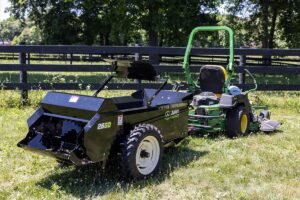
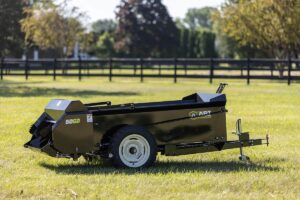
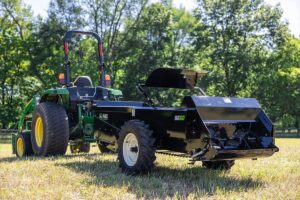
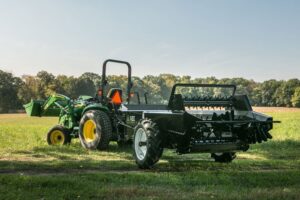
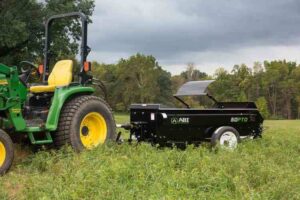
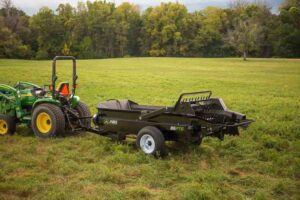
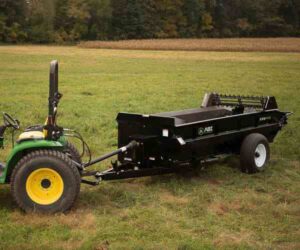
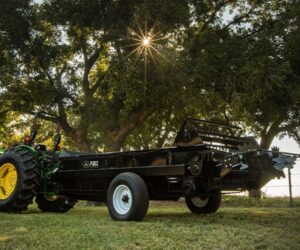
COR-TEN isn’t just more rust-resistant. It’s also physically stronger than standard mild steel, about 39 percent stronger, to be specific. That extra strength lets ABI build a spreader that is both lighter and more durable at the same time. That matters most on our Ground-Drive spreaders (spreaders powered by their own wheels, light enough to pull behind an ATV or UTV), where a lighter machine puts less weight on your pasture. Less weight means less soil compaction, or ground packed down hard from repeated heavy equipment. University extension research from Mississippi State and Cornell both confirm that heavy equipment traffic is a direct driver of soil compaction, and that compaction is genuinely tough on soil health once it happens.

Durability isn’t only about the box. Our high-speed shredder-beater, the part that chops manure into fine pieces as it spreads, uses hardened teeth built to resist daily wear. Breaking manure down into finer material also reduces strain on the chains and gearboxes, so the whole machine holds up as long as the box does.
A lower price today doesn’t mean it’s actually cheaper. Consider what each option really costs over time:
The real question isn’t what a spreader costs today. It’s what it costs you per year you actually own it.
Even great steel benefits from a little care. The upkeep is simple:
We design our Performance Surface Machines with open boxes and easy-to-reach grease points, so this kind of upkeep takes a few minutes, not a whole afternoon.
Learn which ABI manure spreader is for you by using Machine Match.
Urea: A nitrogen-based compound found in urine and manure. On its own, urea is fairly stable. It becomes a problem for steel only after it starts breaking down.
Urease: An enzyme naturally present in manure and in the bacteria that live in it. Urease is what triggers the breakdown of urea into ammonia. Without urease, urea would break down far more slowly, and the corrosion problem inside a spreader box would be much smaller.
Ammonia: The gas responsible for manure’s sharp smell, and the direct byproduct of urea breaking down. Ammonia dissolved in moisture creates an alkaline, chemically reactive environment, meaning it has the opposite chemistry of an acid, and that environment attacks the surface of ordinary steel.
Corrosion: The general term for a metal breaking down through a chemical reaction with its environment. Rust is one type of corrosion. Manure-driven corrosion happens faster than ordinary weather-driven rust because ammonia is a more aggressive chemical attacker than plain rainwater.
Galvanization: The process of coating steel in a thin layer of zinc to protect it from rust. Galvanizing is a real, legitimate protection method, and it works well right up until that zinc layer is scratched or worn through. Once the zinc is breached, the steel underneath has no more protection than bare steel would.
Mild steel: The plain, standard steel used in most affordable equipment. It has no built-in resistance to the kind of chemical attack manure produces, which is why it needs a coating like paint or galvanizing to survive at all.
COR-TEN steel: A steel alloy, meaning a steel blended with small amounts of other elements such as copper, chromium, and nickel, that is engineered to form its own rust-colored protective coating instead of rusting straight through. COR-TEN was originally developed in the 1930s for railroad hopper cars hauling coal and ore, where its toughness and low maintenance made it a natural fit. Decades later, in the 1950s and ’60s, builders and architects discovered the same properties made it ideal for bridges and buildings, and it has been proven through both applications ever since.
Patina: The warm, copper-brown protective layer that forms on the surface of COR-TEN steel over time. Unlike ordinary rust, the patina is dense and tightly bonded to the steel underneath, which is what allows it to actually block oxygen and moisture from reaching the metal.
Wet-dry cycling: The repeated pattern of a surface getting wet and then drying out. COR-TEN’s protective patina depends on this cycle to form properly. A spreader that never gets a chance to dry between uses will not develop as strong a patina as one that is rinsed and allowed to dry.
Soil compaction: Ground that has been packed down hard, usually from repeated heavy equipment or livestock traffic, which reduces the air and water space in the soil that plant roots need to grow. Compacted soil holds less water, drains poorly, and supports weaker pasture growth over time.
Yield strength: A measurement of how much stress a material can handle before it starts to permanently bend or deform. Steel with a higher yield strength can be built into thinner, lighter components while still holding the same load, which is part of why COR-TEN allows for lighter equipment builds.
Shredder-beater: The mechanical part of the spreader that chops and flings manure into fine, even pieces as it spreads, rather than dropping it out in heavy clumps.
Ground-Drive spreader: A style of spreader that gets its spreading power from its own wheels turning as it moves, rather than from a separate power source like a tractor’s PTO. Ground-Drive spreaders are typically light enough to tow behind an ATV or UTV.
Machine Match: A product picker by ABI Attachments, which is made for their customers and website visitors to learn which ABI product is for them.
Just one thing. It needs to dry out between uses. Rinsing your spreader and letting it dry between loads is what keeps the protective patina working the way it’s supposed to.
Yes, in a way. The smell comes from ammonia gas, and that same ammonia is what drives the corrosion. COR-TEN’s protective patina is built to withstand exactly this kind of ongoing chemical wear.
It’s harder to weld than regular steel, requiring skilled, experienced welders to do it right. ABI uses it anyway because we build equipment meant to run for decades, not just through the warranty period.
No. It looks rust-colored, but it isn’t ordinary rust. Regular rust is loose and flaky, and it traps moisture against the metal, which keeps the damage going. COR-TEN’s patina is tight and dense, and it actually seals the steel away from air, moisture, and manure chemistry.
No obligation.
Mon-Thurs 8AM – 8PM and Fri 8AM – 5PM EST
To apply for financing and to learn about our latest financing promotions call 877.788.7253. Financing programs are offered by Sheffield Financial, a division of Truist Bank. Member FDIC. Subject to credit approval. Approval, and any rates and terms provided, are based on credit worthiness. Other financing offers are available. See your local dealer for details. Bureau risk score alone does not guarantee rate eligibility; other underwriting criteria may apply. Minimum amount financed $1500.00; Maximum amount financed $75,000.00. Other qualifications and restrictions may apply. An Origination Fee of $150.00 will be added to the amount financed in the above example. Offer effective on eligible and qualified units purchased from a participating Sheffield dealer. See dealer for product eligibility and qualifications between 8/1/2026 and 10/31/2026. Offer subject to change without notice