
Why black water tanks block algae and outlast white tanks under UV exposure, the carbon black science behind it, and the one trade-off worth knowing.

Algae requires three things to establish itself: water, nutrients, and light to drive photosynthesis. Water and nutrients are almost always present in any stored source, which leaves light as the one variable tank design can actually control. A genuinely opaque black tank leaves stored water in total darkness, cutting off algae’s growth mechanism at the source. White and translucent plastic does the opposite: light passes straight through to the water inside, and over weeks of sun exposure, that’s the mechanism by which clear water turns green.
Fewer algae blooms also means fewer chemical inputs. Because black tanks prevent this biological growth naturally, operations using them typically spend meaningfully less on sanitizers, treatment chemicals, and the frequent tank flushing that translucent tanks tend to require just to stay ahead of buildup.
Here’s the detail that separates a real explanation from a marketing claim: black polyethylene tanks work because of a specific compound, carbon black, mixed directly into the resin during manufacturing. Across independent plastics-industry and materials-science sources, carbon black is consistently identified as the single most effective, most economical UV stabilizer available for polyethylene, absorbing radiation across the solar spectrum and converting it to harmless heat instead of letting it attack the plastic’s molecular structure.
Without that protection, UV exposure causes photodegradation, a breakdown process that shows up as cracking, fading, chalking, and real loss of mechanical strength over time. White and translucent tanks, lacking that same UV-absorbing pigment, measurably degrade faster under identical sun exposure. A properly built black tank can last years longer outdoors for exactly this reason, not because black is simply the “tougher-looking” color, but because of what carbon black is doing at the molecular level. Compare ABI water trailer models built with this in mind →
Black tanks absorb significantly more solar heat than white ones, and the water inside genuinely runs warmer as a result. Materials-industry sources are consistent on this point: even though black tanks measure hotter overall, the UV protection carbon black provides outweighs the heat increase when it comes to the tank material’s long-term durability.
But the water itself is a separate question from the tank material. Warmer water can accelerate the growth of certain bacteria if the water was already contaminated going in, and it’s simply less pleasant to drink than cool water. This is the honest trade-off underneath the pitch: a black tank wins decisively against light-driven algae growth and UV degradation of the plastic, while taking on a heat-management consideration a white tank never has to deal with.
Feature | Black Water Tank | White Water Tank |
Algae growth | Effectively blocked | Likely in sunlight over time |
UV / material lifespan | Long-lasting, protected by carbon black | Degrades faster, cracking and brittleness over time |
Water temperature | Heats up more in direct sun | Stays cooler |
Fluid level visibility | Can’t see the water level | Easy to see at a glance |
Chemical treatment needs | Typically lower | Typically higher, to manage algae |
Not sure which column matches your use case? Browse ABI’s full Water Trailer lineup and see both tank options on every model →
One detail worth knowing before assuming any dark tank delivers these benefits: true opacity depends on how thoroughly carbon black is compounded into the resin during manufacturing, not on how dark the tank looks from the outside. A tank with a light surface tint or an under-dosed colorant can appear black without achieving the light-blocking, UV-stabilizing performance a properly compounded resin delivers. This is part of why building a genuinely opaque, UV-stable black tank is a more demanding manufacturing process than molding a tank in whatever dark-looking base resin is cheapest.

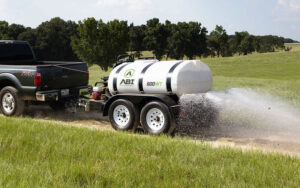
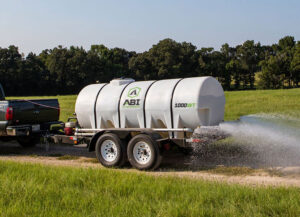
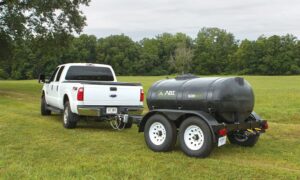
ABI puts this decision directly in your hands rather than defaulting you into one option. Every trailer in the lineup, the 500 gallon, 1,000 gallon, and 1,600 gallon models, offers a choice between a white tank for easy fill visibility and a black tank engineered specifically to reduce algae growth during storage. See the full Water Trailer lineup →
For potable, drinking-grade water specifically, ABI’s Potable Water Trailers default to full-drain black tanks, exactly because reducing algae and bacterial growth matters most where the water is meant for consumption and may sit for longer stretches between fills. See ABI Potable Water Trailers →
Every ABI tank, regardless of color, is also rotationally molded to fully drain, worth knowing on its own. Many competitor tanks don’t fully drain, leaving residual water and sediment behind that gives algae and bacteria a foothold no matter what color the tank is. Tank color solves the light problem. Full drainage solves the leftover residue problem. Getting the real benefit means both are working together.

A black water tank isn’t just a darker-looking version of a white one. It’s a different engineering approach, built around a pigment that blocks the light algae needs and protects the plastic itself from UV breakdown, at the cost of running hotter and losing the ability to see your fill level. A white tank trades that protection for visibility and a cooler-running tank. Neither is universally right. What matters is matching the tank to how long your water actually sits and what you need from it while it does. See the full ABI Water Trailer lineup →


Not reliably. A tank can appear dark without being manufactured with a fully compounded carbon black resin. True light-blocking and UV-stabilizing performance depends on how the pigment is actually processed into the plastic, not just the surface color.
The carbon black pigment compounded into the plastic is recognized as one of the most effective, most economical UV stabilizers available for polyethylene. It absorbs and dissipates UV radiation as heat instead of letting it degrade the plastic, which is why white and translucent tanks tend to crack and fade.
A properly compounded, genuinely opaque black tank leaves the interior in total darkness, cutting off the light algae needs for photosynthesis. That’s a meaningfully more effective barrier than a translucent white tank, where light passes through and can drive algae growth over time.
No obligation.
Mon-Thurs 8AM – 8PM and Fri 8AM – 5PM EST
To apply for financing and to learn about our latest financing promotions call 877.788.7253. Financing programs are offered by Sheffield Financial, a division of Truist Bank. Member FDIC. Subject to credit approval. Approval, and any rates and terms provided, are based on credit worthiness. Other financing offers are available. See your local dealer for details. Bureau risk score alone does not guarantee rate eligibility; other underwriting criteria may apply. Minimum amount financed $1500.00; Maximum amount financed $75,000.00. Other qualifications and restrictions may apply. An Origination Fee of $150.00 will be added to the amount financed in the above example. Offer effective on eligible and qualified units purchased from a participating Sheffield dealer. See dealer for product eligibility and qualifications between 8/1/2026 and 10/31/2026. Offer subject to change without notice