
Reduce the number of active scarifiers to concentrate downforce, and angle the scarifiers forward at 30–40 degrees so the tool cuts into hard pan rather than skimming over it. Here’s the physics and the step-by-step setup.
Hard pan is a compacted layer of soil or sub-base material that resists penetration. It forms in two main ways:
Natural hard pan develops below the topsoil when fine clay particles, calcium, and iron minerals bind tightly together, often becoming nearly impervious to water infiltration. High clay content is the primary driver because clay particles pack so densely that drainage stops.
Manmade hard pan is the version most gravel driveway and food plot owners deal with. Repeated vehicle traffic compacts material beneath the surface layer. Repeatedly tilling or discing a food plot or garden at the same depth compounds the problem, the tillage loosens the top layer but presses a compaction layer just below the working depth with every pass. Over time, that layer becomes hard pan.
Why it matters for gravel driveways: Hard pan beneath the surface prevents gravel from keying in, which is what causes recurring potholes and washboard that return days after grading. On a food plot, it blocks root penetration and drainage. Fixing the symptom without addressing the hard pan is a cycle that never ends.
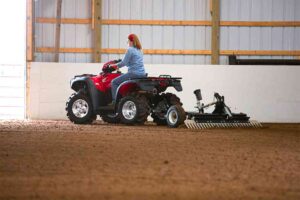
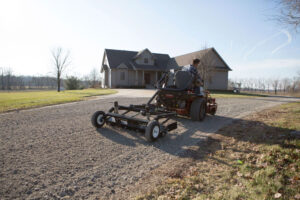
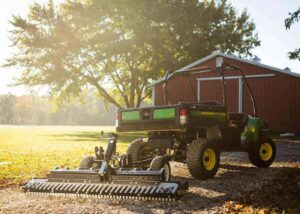
A pull-behind ATV or UTV drag works by distributing its weight across multiple scarifier contact points. That’s ideal for routine maintenance, if you want even coverage. But it works against you when facing hard pan.
The physics: force per contact point = total tool weight ÷ number of active scarifiers. A 340-pound drag with 7 scarifiers delivers approximately 49 lbs per contact point. That’s enough to groom loose gravel or scratch compacted soil, but not enough to fracture a locked hard pan surface.
Compare this to a three-point tractor attachment, which can apply hydraulic downforce far beyond the tool’s own weight. A pull-behind drag only has gravity. You can’t add hydraulic pressure, but you can concentrate what you have.
This is the nail board principle: a person lying on a board of 500 nails is unharmed, the weight spreads across every point. Reduce that to 4 nails and it penetrates. The physics of breaking hard pan with a pull-behind drag work exactly the same way.
| Active Scarifiers | Downforce Per Point |
| 7 (standard maintenance) | ~49 lbs |
| 4 (hard pan setup) | ~85 lbs |
Removing three scarifiers nearly doubles the downforce per point, no modifications, no added weight, no new equipment. On the Gravel Rascal Pro, scarifiers pin into pockets on the tool frame and can be removed and reinstalled without tools or damage.
Complete setup for maximum penetration:
For other tool sizes or models, use the same formula: tool weight ÷ active scarifier count = downforce per point. Four to five contact points is the effective range for most full-width ATV drags on hard pan.
The angle at which a scarifier contacts the ground determines whether the tool’s forward motion helps or fights penetration.
| Angle | Mode | Effect |
| Angled backward (trailing) | Grooming | Skims the surface, ideal for maintenance, counterproductive for hard pan |
| Perpendicular to ground | Scratching | More aggressive scratch, but forward motion tends to push the tip upward |
| Angled forward 30–40° | Cutting | The tip leads in the direction of travel; hard pan resistance pulls the tip deeper |
At 30–40 degrees forward of perpendicular, the scarifier acts like a chisel driven at an angle, forward motion and ground resistance work together to push the tip in rather than back it off. This is the position you want for hard pan.
Set the forward angle and make a short test pass. The tip should visibly be leading. If the tool is skating over the surface, check both the angle and your scarifier count.
Gravel driveways: Scarification is your primary tool. The two techniques above reduced contact points and forward angle are the mechanical solution. Once the hard pan layer is cracked, surface gravel can key into the loosened material and hold its condition under traffic.
Food plots, gardens, and new lawn areas: Mechanical scarification helps, but hard pan in a soil context often has chemical drivers. High calcium and iron concentrations, high clay content, and high soil pH all contribute to particle binding. After mechanical breaking, have a soil test done and consult your local university extension service about amendments for your specific soil type and intended planting. Loosening without addressing the chemistry means the hard pan can reform.
Breaking hard pan with a pull-behind ATV or UTV drag is achievable with equipment you already own. The two adjustments, fewer active scarifiers to concentrate downforce and forward scarifier angle to cut rather than skim, take minutes to make and require no additional tools.
For the 5.5 ft Gravel Rascal Pro, the target hard pan setup is four active scarifiers at a 30–40 degree forward angle, gauge tires raised, finish rake out of play. Multiple passes and cross-cuts complete the job. Once the surface is cracked, put everything back to standard configuration and finish the surface.
On a 5.5 ft Gravel Rascal Pro, removing three of seven scarifiers takes per-point downforce from approximately 49 lbs to approximately 85 lbs, close to double. For other ABI tool sizes, divide the tool’s total weight by your target scarifier count. Four to five contact points is typically the working range for a full-width ATV drag on hard pan.
No. Scarifiers on the Gravel Rascal Pro pin into pockets on the tool frame, removal is non-destructive and fully reversible. Store the removed scarifiers safely and reinstall them for standard maintenance work after the hard pan session.
Approximately 30–40 degrees forward of perpendicular, the tip is clearly leading as you move forward, not trailing. The exact position depends on your tool’s pocket geometry. Make a short test pass, observe whether the tips are digging in or skating, and adjust from there.
Not always. Recently formed or shallow hard pan may crack in a single pass. Deep or long-established compaction can require multiple passes in different directions, including diagonal cross-cuts, before the layer fully releases. Once the surface is cracked, a finishing pass with all scarifiers reinstalled will clean it up.
Yes. This is physics, not a product-specific feature. Any pull-behind drag with removable or adjustable scarifiers can apply the same principle: calculate weight per contact point, reduce to maximize force, set a forward engagement angle. The math is universal.
Potholes and washboard are surface symptoms of subsurface instability. Gravel needs to key into a loose, stable base to resist displacement under traffic. When hard pan is present below, the surface material has nothing to lock into, vehicles push it around, low spots form, and the fill-and-pothole cycle repeats. Breaking the hard pan and allowing gravel to consolidate into the loosened base is what ends the cycle for good.
To apply for financing and to learn about our latest financing promotions call 877.788.7253. Financing programs are offered by Sheffield Financial, a division of Truist Bank. Member FDIC. Subject to credit approval. Approval, and any rates and terms provided, are based on credit worthiness. Other financing offers are available. See your local dealer for details. Bureau risk score alone does not guarantee rate eligibility; other underwriting criteria may apply. Minimum amount financed $1500.00; Maximum amount financed $75,000.00. Other qualifications and restrictions may apply. An Origination Fee of $150.00 will be added to the amount financed in the above example. Offer effective on eligible and qualified units purchased from a participating Sheffield dealer. See dealer for product eligibility and qualifications between 8/1/2026 and 10/31/2026. Offer subject to change without notice
No obligation.
Mon-Thurs 8AM – 8PM and Fri 8AM – 5PM EST