
Arena moisture management is the controlled regulation of water content within an arena footing system to maintain consistent surface behavior, rider performance conditions, and footing stability over time.
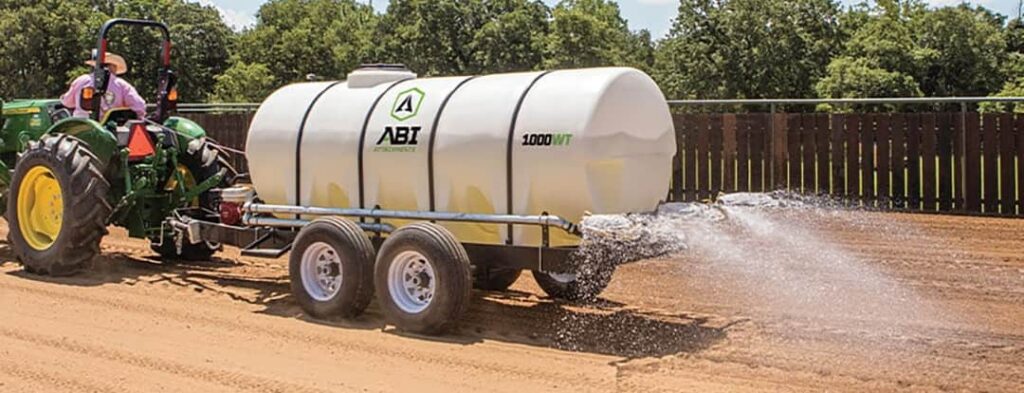
In equestrian arenas, moisture is not simply “added water.” It is a structural component of how footing behaves mechanically under hoof impact, turning forces, acceleration, and repeated traffic.
Proper moisture management influences:
It is one of the most important and misunderstood aspects of arena maintenance.
Water is not separate from the footing profile. In most arenas, it actively changes how footing particles interact.
Depending on footing composition, moisture can:
Because of this, moisture behaves more like a performance modifier within the footing system rather than simply a surface condition.
Arena footing behaves as a granular material system. Water changes the relationship between particles through several mechanisms.

Small amounts of moisture can create weak capillary bonding between particles.
This helps:
In sand-based systems, this is one reason lightly moist footing often feels more stable than completely dry footing.
However:
At that point, footing may feel heavy or compacted.

Moisture strongly affects how footing resists horizontal movement under hoof forces.
This influences:
If footing becomes:
The goal is controlled resistance, not maximum firmness.

Moisture also affects how force moves through the footing profile.
Balanced moisture helps:
Poor moisture balance can create:
One of the most important realities in arena management:
moisture naturally becomes uneven over time.
This happens because water movement is dynamic and affected by multiple variables.

Water moves downward through pore spaces after irrigation or rainfall.
Moisture can move laterally between particles, especially in finer materials.
Surface layers dry faster than deeper layers due to:
High-traffic areas compress pore space, changing how water infiltrates and redistributes.
This is why:
often develop different moisture behavior than the center of the arena.
Different footing systems manage water differently.
Characteristics:
Management implications:


Characteristics:
Management implications:
Characteristics:
Management implications:


Some engineered footing systems:
However:
A common misconception is:
arena moisture management = watering
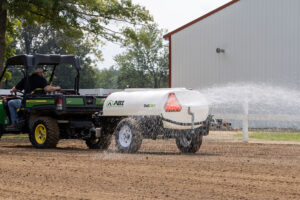
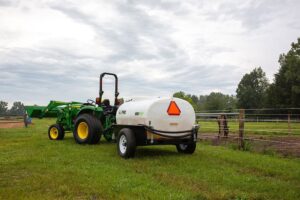
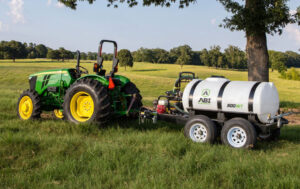
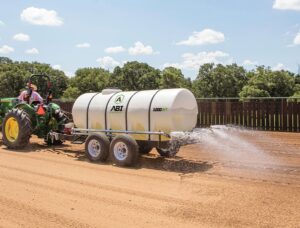
In reality, irrigation is only the input side of the system.
True moisture management also includes:

Mechanical conditioning equipment directly affects moisture behavior.
Poor grooming practices can:
Well-adjusted grooming systems help maintain:
more repeatable footing response across the arena surface.
More water does not automatically mean better footing.
Excess moisture may:
In severe cases:
This is especially important in fine-particle or clay-heavy systems.
Arena moisture behavior changes based on:
For example:
There is no universal watering schedule that works everywhere.

There is no perfect universal moisture level for all arenas.
The goal is:
maintaining a consistent and predictable footing response within the intended discipline and footing system.
This means moisture targets differ between:
Arena moisture management is the continuous balancing of water distribution, footing structure, drainage behavior, and mechanical conditioning to maintain consistent arena performance over time.
It is not simply watering the arena. It is a dynamic systems-management process influenced by:
Well-managed moisture helps maintain:
Poor moisture management, by contrast, is one of the fastest ways to create inconsistent footing and accelerated surface degradation.
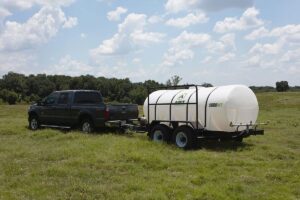
Arena moisture management is the process of controlling water content within arena footing to maintain consistent surface performance and footing stability.
Moisture changes how footing particles interact, affecting traction, compaction, cushioning, dust generation, and overall surface consistency.
Yes. Overly dry footing may become loose, dusty, unstable, and inconsistent under hoof impact.
Yes. Excess moisture can increase compaction, reduce pore space, slow drainage, and create heavy or unstable footing conditions.
Yes. Sand, fiber, clay, and synthetic footing systems all respond differently to moisture and require different management strategies.
Grooming redistributes moisture, breaks up compaction zones, and helps maintain consistent footing structure across the arena.
To apply for financing and to learn about our latest financing promotions call 877.788.7253. Financing programs are offered by Sheffield Financial, a division of Truist Bank. Member FDIC. Subject to credit approval. Approval, and any rates and terms provided, are based on credit worthiness. Other financing offers are available. See your local dealer for details. Bureau risk score alone does not guarantee rate eligibility; other underwriting criteria may apply. Minimum amount financed $1500.00; Maximum amount financed $75,000.00. Other qualifications and restrictions may apply. An Origination Fee of $150.00 will be added to the amount financed in the above example. Offer effective on eligible and qualified units purchased from a participating Sheffield dealer. See dealer for product eligibility and qualifications between 8/1/2026 and 10/31/2026. Offer subject to change without notice
No obligation.
Mon-Thurs 8AM – 8PM and Fri 8AM – 5PM EST